.png)
30s of Therapy: Advanced Stroke Rehabilitation: How Neuroplasticity and Dual-Task Training Are Transforming Recovery
- bmpt862

- May 8
- 4 min read
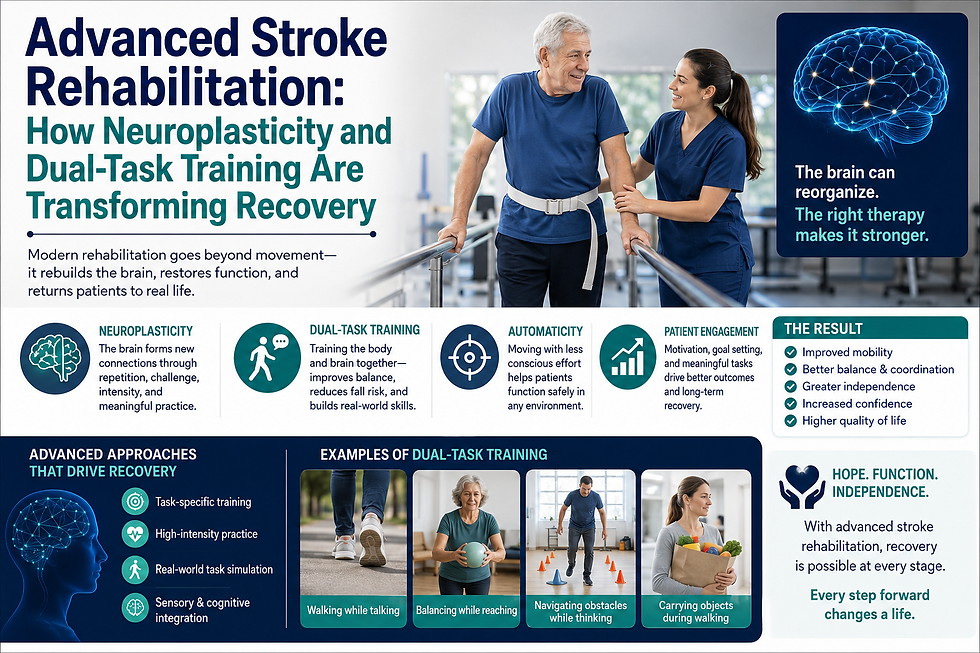
Stroke recovery is no longer limited to repetitive exercises and passive movement training. Today, advanced stroke rehabilitation focuses on neuroplasticity, dual-task training, and real-world functional recovery to help patients regain independence and improve quality of life.
For clinicians, this means creating therapy that challenges both the brain and body. For patients and families, it means recovery can continue far beyond the early stages after stroke.
What Is Advanced Stroke Rehabilitation?
Advanced stroke rehabilitation combines neuroplasticity, motor relearning, dual-task training, and high-intensity functional practice to restore movement in real-life situations—not just inside the clinic. Instead of isolated exercises alone, therapy now includes activities like walking while talking, balancing while reaching, or carrying objects during gait training to improve automatic and safe movement.
Why Neuroplasticity Matters After Stroke
Neuroplasticity is the brain’s ability to reorganize and create new neural connections after injury.Recovery improves when therapy includes repetition, challenge, intensity, and meaningful movement. Neuroplasticity is the brain’s ability to reorganize and create new neural connections after injury. Recovery improves when therapy includes repetition, challenge, intensity, and meaningful movement.
Recovery Potential ∝ Repetition + Challenge + Intensity + Motivation
This is why modern stroke rehabilitation focuses on active participation and task-specific training rather than passive movement alone.
The Importance of Dual-Task Training
Daily life requires people to move while thinking, talking, or reacting to distractions. That is why dual-task training has become essential in advanced stroke recovery.
Examples include:
Walking while talking
Balancing while reaching
Navigating obstacles while thinking
These strategies help rebuild automatic movement patterns, improve balance, and reduce fall risk.

Rebuilding Automaticity After Stroke
After stroke, many patients must consciously think about every movement. Advanced rehabilitation helps restore automaticity so movements become more natural and efficient again.
Clinicians may use:
Obstacle navigation
Walking with cognitive tasks
Visual scanning exercises
Functional mobility training
The goal is to improve confidence, adaptability, and real-world safety.
Modern Approaches to Gait and Upper Extremity Recovery
Advanced gait training now includes speed changes, balance challenges, sensory input, and cognitive distractions to improve real-life walking ability. For upper extremity recovery, therapists use repetitive and functional tasks such as reaching, throwing, bilateral training, and constraint-induced movement therapy to stimulate neuroplasticity and motor recovery.
Why Patient Engagement Matters
The course highlights that motivation and engagement directly affect recovery outcomes. Patients improve more when therapy feels meaningful, measurable, and goal-oriented.
Modern clinicians now focus on:
Functional goals
Patient confidence
Real-world movement
Independence in daily activities
This patient-centered approach improves mobility, balance, endurance, and quality of life.
Final Thoughts
Advanced stroke rehabilitation is transforming how clinicians approach recovery and how patients regain independence. Recovery is no longer just about moving a limb. It is about rebuilding function, confidence, automaticity, and participation in daily life through neuroplasticity, dual-task training, and functional movement practice.
References: |
MedBridge Stroke Rehabilitation: The Advanced Interventions Course (Recorded Webinar) Mike Studer, PT, MHS, NCS, CEEAA, CWT, CSST 1. Brustio PR, Magistro D, Zecca M, Rabaglietti E, Liubicich ME. Age-related decrements in dual-task performance: comparison of different mobility and cognitive tasks. A cross sectional study. PLoS ONE. 2017;12(7):e0181698. 2. Carl DL, Boyne P, Rockwell B, et al. Preliminary safety analysis of high-intensity interval training (HIIT) in persons with chronic stroke. Appl Physiol Nutr Metab. 2017 Mar;42(3):311-318. doi: 10.1139/apnm-2016-0369. Epub 2016 Nov 21. 3. Crozier J, Roig M, Eng JJ, MacKay-Lyons M, et al. High-Intensity Interval Training After Stroke: An Opportunity to Promote Functional Recovery, Cardiovascular Health, and Neuroplasticity. .Neurorehabil Neural Repair. 2018 Jun;32(6-7):543-556. doi: 10.1177/1545968318766663. Epub 2018 Apr 20. Review. 4. Dørum ES, Alnæs D, Kaufmann T, Richard G, et al. Age-related differences in brain network activation and co-activation during multiple object tracking. Brain Behav. 2016;7;6(11):e00533. eCollection 2016 Nov. doi:10.1002/brb3.533 5. Guadagnoli M, Lee T. Challenge Point: A Framework for Conceptualizing the Effects of Various Practice Conditions in Motor Learning. J Mot Behav. 2004 Jun;36(2):212-24. doi: 10.3200/JMBR.36.2.212-224. 6. PMID: 15130871, doi: 10.3200/JMBR.36.2.212-224 7. Kal E, Winters M, van der Kamp J, et al. Is implicit motor learning preserved after stroke? A systematic review with meta-analysis. Baron J-C, ed. PLoS ONE. 2016;11(12):e0166376 8. McIsaac T, Lamberg E, Muratori L. Building a framework for a dual task taxonomy. BioMed Research International. vol. 2015, Article ID 591475, 10 pages, 2015. 9. Plummer P, Zukowski LA, Giuliani C, Hall AM, Zurakowski D. Effects of physical exercise interventions on gait-related dual-task interference in older adults: a systematic review and metaanalysis. Gerontology. 2015;62(1):94-117. doi:10.1159/00037 1577. Epub 2015 Feb 19. 10. Plummer P, Eskes G. Measuring treatment effects on dual-task performance: A framework for research and clinical practice. Frontiers in Human Neuroscience. Front Hum Neurosci. 2015; 9:225. Published online 2015 Apr 28. 11. Schinkel-Ivy A, Huntley AH, Inness EL, Mansfield A. Timing of reactive stepping among individuals with sub-acute stroke: effects of “single-task” and “dual-task” conditions. Heliyon. 2016;2(10):e00186. Published online 2016 Oct 31. 12. Studer, M, Winningham, R. Retraining Automaticity: Recovering the Procedural Memory of Walking After Stroke. Austin Publishing Group. Published online 2017 October 20. 13. Wiener J, McIntyre A, Janssen S, et al. Effectiveness of High-Intensity Interval Training for Fitness and Mobility Post Stroke: A Systematic Review.PM R. 2019 Aug;11(8):868-878. doi: 1002/pmrj.12154. Epub 2019 May 30. 14. Wulf, G, Lewthwaite, R. Optimizing Performance Through Intrinsic Motivation and Attention for Learning: The OPTIMAL Theory of Motor Learning. Psychon Bull Rev. 2016 Oct;23(5):1382-1414. doi: 10.3758/s13423-015-0999-9. 15. Yang L, He C, Pang MY. Reliability and validity of dual-task mobility assessments in people with chronic stroke. PLoS One. 2016;11(1): e0147833. doi:10.1371/journal.pone.0147833. |


Comments